Itaúsa is a holding company with equity participation in other businesses. Generally speaking, the company is responsible for the shareholding control of large businesses, among which the most representative is Itaú Unibanco S.A.
What is a Holding?
Holding comes from the English term Hold which means, in free translation, to hold. In the market, this definition makes sense when we analyze the operations of companies of this nature.
The term holding emerged to designate a management company of participations, which exercises control over companies by “holding” its share of social capital.
The main objective of a holding is the administration and control of one or more companies. The controlling company is the one that makes decisions regarding the management of the business, and this is what Itaúsa does.
By holding the shareholding control, the company receives its share of the profits from the businesses and, in this way, distributes the results coming from various companies, as happens at Itaúsa.
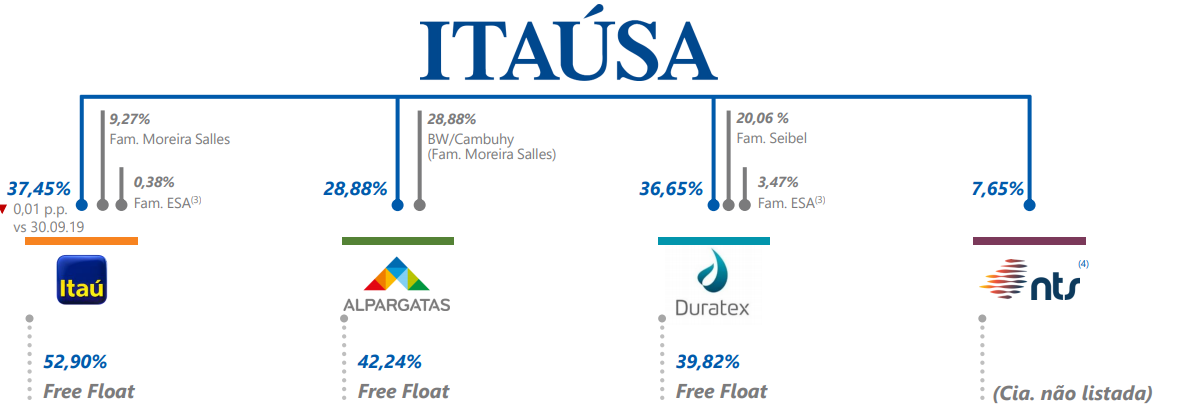
Itaúsa's participation structure
Itaúsa's vast participation structure is composed of 4 major highlights. Among them, we can mention: three publicly traded companies – listed on the stock exchange – and one privately held company.
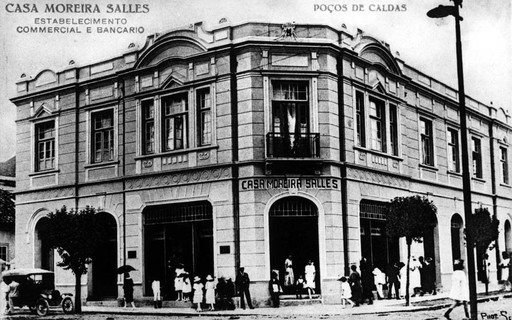
The conglomerate we know today as Itaúsa emerged on May 6, 1966, as a centralizing financial institution. In summary, the creation aimed to channel and optimize decision-making for a group of companies.
Thus, the first investment bank in the country was created, called Banco Federal Itaú de Investimentos S.A. Being a new segment, the creation was only possible with the institutionalization made by the Central Bank of Brazil. From this, what we know today as Itaúsa S.A. emerged.
The goal behind it all was to carry out participation and financing operations to supply capital through the application of its own resources, in addition to making decisions in the businesses in which the company participated.
Conscious growth
After its creation, the company operated heavily in two segments: industrial and financial. In 1970, the investment bank had its name changed to Banco Itaú de Investimento S.A.
A few years later, the company's participation portfolio began to grow, due to the increasing relevance of Banco Itaú in the national scenario. In 1973, it was renamed Banco Itaú Português de Investimento S.A, still as an investment bank and holding of participations.

However, the constant and latent growth of Banco Itaú Português de Investimento S.A led the company to stop operating ambiguously.
Thus, the expansion process resulted in the distinction of the company's segments, which ceased to be an investment bank and a holding of participations. Therefore, it began to adopt only the category of equity participations.
In 1974, for example, the company had participation in more than 50 businesses. Furthermore, in a General Assembly held in December 1974, the company changed its corporate name and social purpose.
Becoming a Holding

Now, under the name Investimentos Itaú S.A, the company's social purpose was to support the national private companies in which it participated.
In the form of a participation company, the company began to invest in the industrial segment, in addition to maintaining its activities in the financial segment.
In 1979, Itautec was created to meet the technological demands of Banco Itaú, with the participation of Investimentos Itaú S.A. Initially, Itautec was focused on the services and needs of the financial institution itself.
However, with the installed production capacity, the company began to provide products and services in the general market. In fact, the name Itaúsa emerged in a General Assembly on April 30, 1991.
Thus, the company began to be called Itaúsa – Investimentos Itaú S.A. At the same time, the 1990s brought significant changes to the group, which, in 1995, acquired Banco Francês e Brasileiro S.A.
With the new acquisition, Itaú Personnalité emerged, and in the same year, Duratex – which had already constituted Itaúsa's investments since 1970 – entered into an agreement with Piazza Hermanos. Thus, it began to be called Deca Piazza and secured a large market share in this movement.
Increase in proportions
In 1997, the companies controlled by Itaúsa made a leap in their growth, mainly with the acquisition of Banco Banerj S.A, and expanded in Rio de Janeiro through Banco Itaú.
One year later, in 1998, the company acquired the shareholding control of Banco do Estado de Minas Gerais, during the process of privatization of the national banking system that was occurring at that time. Additionally, in the external scenario, Itaúsa obtained control of Banco Del Buen Ayre and initiated Itaú Buen Ayre in Argentina.
Growth continued in the following years, and in the 2000s, the company acquired the shareholding control of two major state banks: Banco do Estado do Paraná S.A and, in 2001, Banco do Estado de Goiás.
In 2002, Itaú BBA was created in partnership with BBA Creditansalt. In 2006, operations turned to the Latin market and expanded participation in Chile and Uruguay through agreements with Bank Of America.
In 2008, the controlling entities of Unibanco Holdings and Itaúsa signed a unification agreement aimed at expanding operations and created Itaú Unibanco S.A.
Consolidating in the market

One year later, in 2009, the association between Itaú Unibanco and Porto Seguro occurred. The association implemented the insurance portfolio offered in the residential and automotive segments, through a 30% participation in the company's results.
In retrospect, Itaúsa's acquisition portfolio experienced a significant escalation, thus favoring a scenario of pioneering. In 2017, it was Alpargatas' turn to join the group, through an acquisition of R$ 3.5 billion.
In the same year, Itaúsa took advantage of the unfolding of participatory positions in NTS and acquired approximately 7.65% of its social capital, which cost US$ 292.3 million. During these years, Duratex made heavy acquisitions and consolidated itself as the largest in its segment.

Since then, Itaúsa has been participating in major market movements, keeping an eye on external activities and the internal scenario. National investments resulted in an agreement with XP Investimentos, and in the international scenario, the international operations of Itaú Unibanco were expanded.

 15
15 1
1


