
Company Data
CNPJ
Market Cap
Number of Shares
Listing Segment
IPO Date
Key Indicators
P/E
P/VP
DY
Tag Along
Free float
Viability Seal

We use cookies that are necessary for the site to work and, with your permission, analytics and marketing cookies to improve your experience. You can accept all of them or choose what to allow.
Company Data
CNPJ
Market Cap
Number of Shares
Listing Segment
IPO Date
Key Indicators
P/E
P/VP
DY
Tag Along
Free float
Viability Seal
See what thousands of investors think and vote on the assets you consider viable
excelente apresentação do resultado atual da empresa.
Por favor atualizar os Indicadores de eficiência
 9
9Vários dados faltando na tabela de balanço e também nos indicadores de eficiência.
2dados desatualizados....
2Company Data
CNPJ
17.344.597/0001-94
Market Cap
R$84B
Number of Shares
1.94B
Listing Segment
NOVO MERCADO
IPO Date
4/29/2013
Key Indicators
P/E
9.15
P/VP
7.72
DY
10.55%
Tag Along
100.00%
Free float
31.74%
Viability Seal
Find out whether the asset is viable or a dud
Loading data
Loading...
Discover whether an asset is an opportunity or a risk through our seal.


CASH3
Méliuz S.A

PETR4
Petróleo Brasileiro S.A Petrobras

ABEV3
Ambev S.A

ITUB3
Itaú Unibanco Holding S.A
The stock is undefined relative to the fair price by the Graham formula.
R$43.52
The stock is undefined relative to the fair price by the Bazin formula.
R$43.52
First of all, we need to understand the basic shareholding structure of BB Seguridade. We can see that its majority controller, Banco do Brasil, holds just over 66% of the company's total capital. Conversely, the remaining shares are traded on the market (Free Float).
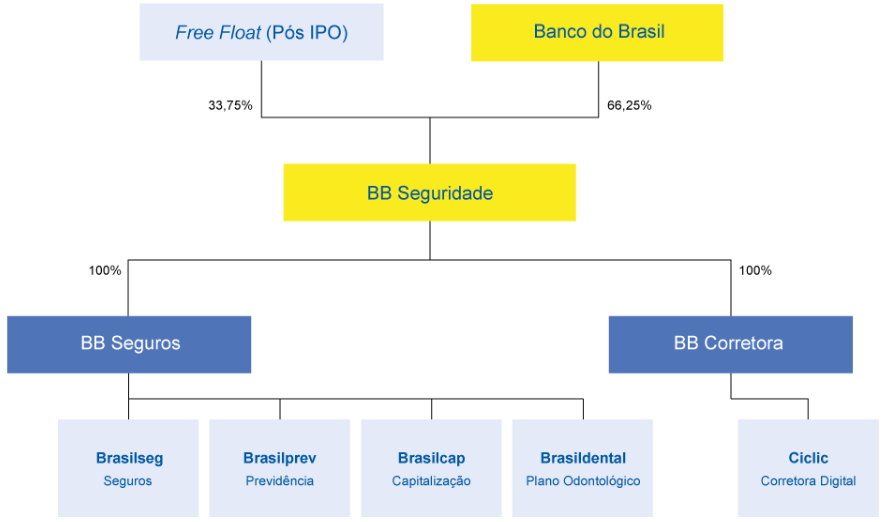
At first, BB Seguridade is an investment company, that is, a holding. In this sense, it holds control of companies that operate in the insurance market. Basically, we can divide its holdings into two segments:
Risk and accumulation businesses: joint ventures or partnerships with private partners that operate insurance products, open pension plans, capitalization, and dental assistance plans.
Distribution businesses: a subsidiary that sells insurance, open pension plans, capitalization bonds, and private dental assistance plans, in addition to an affiliate that operates in the distribution of insurance products through digital channels.
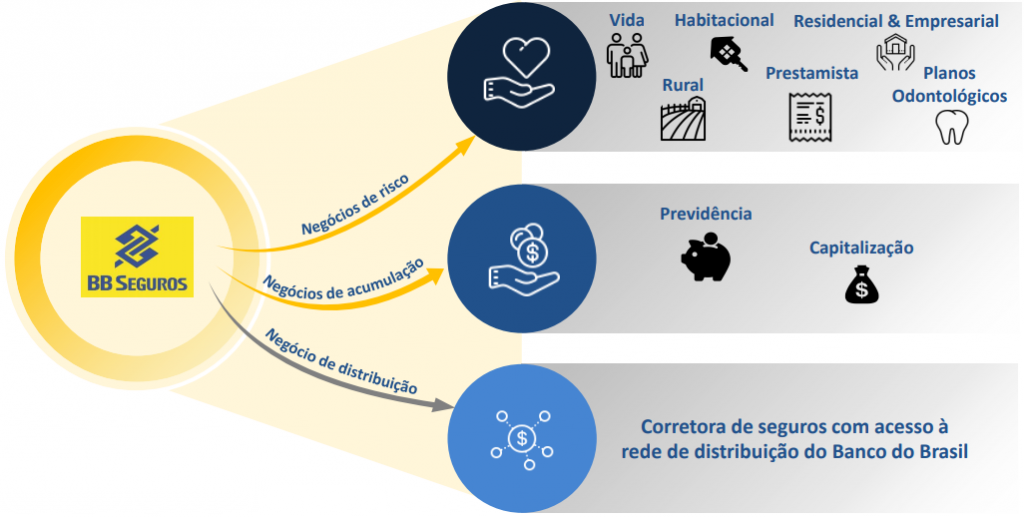
The Company operates with a bancassurance model, that is, it uses the physical, human, and technological structure of Banco do Brasil to sell its products. In this way, it can benefit from all the solidity and tradition of the brand to market the insurance. In other words, the company operates through more than 60,000 physical service points and all the digital channels of the financial institution.
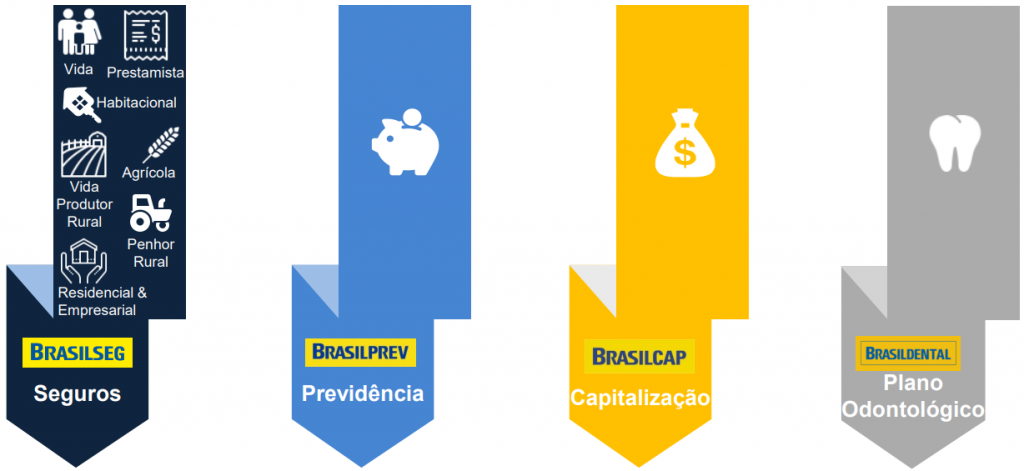
This wholly-owned subsidiary of BB Seguridade holds direct stakes in risk and accumulation businesses. Thus, it controls the following 4 companies: Brasilseg, Brasilprev, Brasilcap, and Brasildental.
The history of BB Seguridade takes us back to 1981, when Banco do Brasil began its insurance operations. Six years later, Banco do Brasil Corretora (BB Corretora) was created to assist in the business and insurance brokerage operations.
At the turn of the 1990s, BB Corretora entered into several collaborative partnerships. The decade is marked by various partnerships, including with:
SulAmérica
Icatí
Aliança da Bahia
Principal Financial Group
From this, the company expands by creating subsidiaries, including:
Brasilprev
Brasilcap
Brasilveículos
The autonomous companies in the insurance segment are linked to the operations of the future Banco do Brasil Seguridades, creating a network of insurances, each with its operations tied to a segment of the insurance industry.
The first steps towards the creation of BB Seguridade were taken in 2008, after a corporate reorganization of the insurance, pension, and capitalization area of Banco do Brasil.
In the following two years, in 2010, the Company formed a partnership with the Spanish group MAPFRE and began activities in two segments:
BB MAPFRE SH1: personal, rural, and housing insurance.
MAPFRE BB SH2: property insurance, mainly automobile and damage.

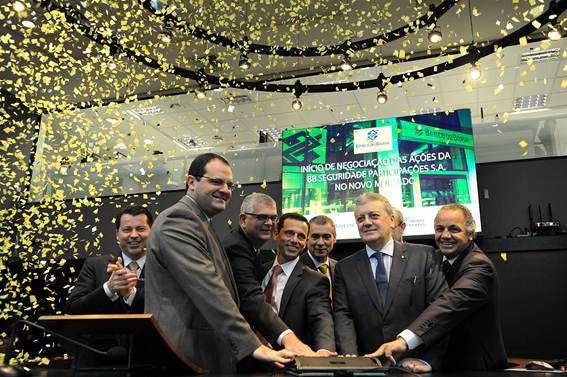
Finally, the creation of BB Seguridade took place in 2012, with an IPO in the Novo Mercado segment of Bovespa the following year in 2013. As a result, 675 million shares were sold, and in the same year, the company already acquired a stake in IRB–Brasil RE S.A (IRBR3)
The contract for the commercialization of insurance products within the structure of Banco do Brasil for a period of 20 years was formalized in 2013. In the following year, a partnership was established with Odontoprev for a period of 20 years, constituting Brasildental.
In 2017, the partnership took a step forward in its digitalization process and created Ciclic in partnership with Principal Financial Group, with an extended operating term of 15 years.
In 2018, there was a restructuring of the partnership with MAPFRE, aiming to focus on the banking channel, and divesting from Auto and Large Risks.

More recently, in 2019, the company completed the sale of all its shares in IRB–Brasil RE S.A., producing a net gain of R$2.3 billion.
Since then, Banco do Brasil Seguridades has been consolidating itself as a major player in the insurance sector. BB Seguridades has become one of the largest companies in the segment, presenting large profit margins and consequently establishing itself as one of the best dividend payers on the Stock Exchange.


